mantle animation image 1 mantle animation image 2 mantle animation image 3 mantle animation image 4

Fixed Income Knowledge Hub

Explore the essential facets of securitization.

What are the benefits of securitized products?

Focusing on securitized products like asset-backed and mortgage-backed securities enables investors to leverage market inefficiencies and underinvestment in securities that have the potential to offer higher credit quality and yield advantages over traditional government or corporate credit securities. This differentiated approach taps into a vast, diverse market often overlooked by index-based investors.

The Securitized Market

Index construction limitations provide an opportunity for active managers who have the flexibility to invest outside of the benchmark.

Source: SIFMA, as of 31 Dec 2021.

Securitization traces its roots to the late 18th century when railroads securitized farms to fund expansion. However, the modern mortgage-backed securities market began in 1970 when HUD created the first residential mortgage-backed security through the Government National Mortgage Association.

This innovation allowed banks to transfer risk and homebuyers to purchase with smaller down payments, significantly expanding homeownership. It extended the American dream to those previously unable to raise substantial down payments.

By 1985, securitization evolved to include non-mortgage assets, starting with automobiles. This marked the beginning of the asset-backed securities (ABS) market, which quickly expanded to include diverse collateral types such as credit cards, equipment, aircraft, private student loans, and cell phone contracts.

This evolution transformed the financial landscape, creating new investment opportunities and funding mechanisms across various economic sectors.

Securitization begins when a lender and borrower agree on loan terms, including amount, interest rate, collateral and maturity. The loan is then sold or pledged to a trust with similar loans, creating a securitized product. Bankers analyze expected cash flows, including interest, principal, prepayments, expected delinquencies and defaults, and recoveries. These cash flows are structured into securities that are broken down into tranches (e.g., Classes A, B, C) and sold to investors.

Historical data on credit trends are readily available for established markets like credit cards and automobiles. Deals may be submitted to rating agencies for review and preliminary rating, considering credit enhancements.

The non-rated securitized deal market has recently grown as issuers avoid rating agency fees, and some securities, like non-performing loans, are challenging to rate. More deals are issued under Rule 144A, which allows private placement without SEC registration. These securities often offer yield compensation due to potentially lower liquidity and may not meet specific institutional or private investor guidelines.
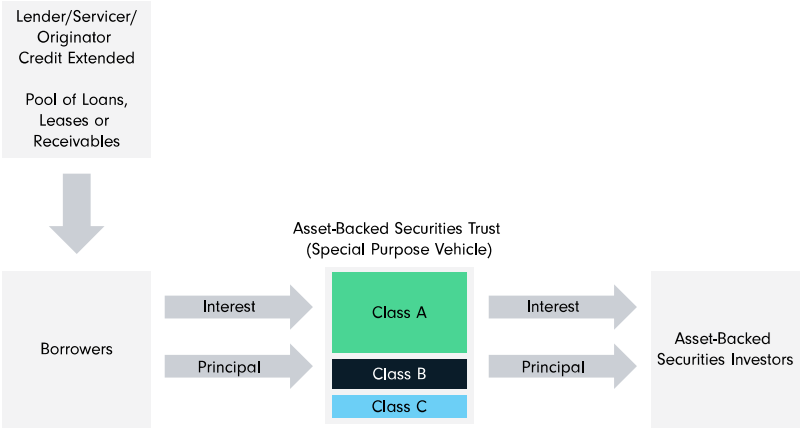
Asset backed securities chart graphic

In the securitized market, issues are divided into tranches with varying degrees of subordination. Each tranche has a different level of credit protection or risk exposure. Typically, a senior class (A tranche) is supported by junior or subordinated tranches (B, C, etc.), with the subordinated tranches absorbing losses first to protect the senior classes.

Senior classes have the first claim on cash flows, while junior classes receive principal payments only after senior classes are fully repaid. This cascading cash flow arrangement is known as a cash flow waterfall. If the underlying asset pool can't cover payments due to defaults, losses are absorbed by subordinated tranches first, protecting the senior tranches until losses exceed the subordinated amounts.

Senior securities, often rated AAA or AA, carry lower risk, whereas subordinated classes have lower credit ratings and higher risk. The most junior class often called the equity class, is highly exposed to default risk and may be retained by the originator for potential profit. This equity class receives any remaining cash flow after all other classes are paid but typically does not receive a coupon, which the issuer retains to show its commitment.

Credit tranche graphic

Credit enhancement is a crucial mechanism in securitization designed to improve the credit quality of asset-backed securities, making them more attractive to investors. Since the underlying assets may carry credit risk or volatile cash flows, additional measures are applied to mitigate these risks. Common methods include external credit support (such as bank guarantees or insurance), and internal structures (such as overcollateralization, reserve accounts, or senior-subordinated tranching). These techniques reduce potential investor losses, increase confidence in the securities, and enable issuers to raise capital at a lower cost.

The primary purpose of securitization is to transform illiquid assets (such as mortgages, auto loans, or credit card receivables) into marketable securities. For the originators, this process helps recycle capital, improve balance sheets, and transfer part of the credit and market risks to investors. For investors, securitization provides access to new investment opportunities, diversified income streams, and tranches tailored to different risk appetites. On a broader scale, securitization enhances market liquidity and efficiency, ensuring a more effective allocation of capital within the economy.

Investing in securitized assets offers several compelling benefits, particularly for fixed income portfolio managers seeking strong risk-adjusted returns. Here are the key advantages:

  1. Diversification and Enhanced Returns: Securitized assets provide an opportunity to diversify beyond traditional fixed income investments like Treasuries, investment-grade corporate bonds, high-yield bonds and emerging markets debt, thereby potentially enhancing the portfolio’s overall risk/return profile.
  2. Inefficiencies and Opportunities: The securitized market often contains inefficiencies that astute investors can exploit, given that it is less explored than mainstream fixed income sectors and potentially offers higher returns.
  3. Credit Enhancements: Many securitized products come with credit enhancements, such as excess spread, reserve accounts, overcollateralization, and subordination. These features reduce credit risk and provide additional security to investors, making these assets more attractive relative to their risk level.
  4. Underrepresentation in Benchmarks: Much of the securitized market is not included in traditional fixed income benchmarks like the Bloomberg US Aggregate Bond Index, meaning securitized assets can serve as a differentiator and allow portfolio managers to access unique opportunities not widely held or tracked.
  5. Market Size and Scope: The securitized market is substantial, valued at over $1.6 trillion, yet only about 8% is included in major bond indices. This vast and largely untapped market offers ample opportunities for investment and portfolio enhancement.

By incorporating securitized assets into their portfolios, investors can achieve better diversification, exploit market inefficiencies, and potentially secure higher returns, all while benefiting from the added protections of credit enhancements.

Investing in securitized assets carries inherent risks, primarily due to the market’s smaller and less liquid nature than corporate or Treasury markets, which can pose significant challenges, as seen during extreme market volatility.

A notable example of unprecedented volatility occurred in March and April 2020. This period was marked by a "run on the bank" scenario, where investors rushed to sell high-quality, short-duration assets into a virtually closed market. This situation surpassed the market turmoil witnessed in both 2008 and 2001. Despite this price volatility, the underlying bonds demonstrated strong credit resilience.

Liquidity risk remains a critical consideration for investors, particularly those with a short-term focus or who attempt to time the market. However, these investments can enhance a bond allocation’s risk/return profile for long-term oriented investors who comprehend the liquidity profile of securitized assets. Understanding and managing these risks is essential for leveraging the potential benefits of securitized assets.

Fixed Income Insights

Events

  • LIVE PODCAST | Unlocking Value in High Yield Markets: Live Insights with Daniel Wu | LISTEN
  • WEBINAR | Fixed Income Update: Looking Back at 2024, Ahead to 2025 | VIEW REPLAY
  • WEBINAR | Markets in Transition: Decoding 2024's Shifts & 2025's Opportunities | VIEW REPLAY

Get acquainted with our fixed income strategies

Core Bond

Our Core Bond strategy is a diversified investment-grade fixed income portfolio with a significant focus on the securitized market to enhance income potential.

Learn more

Core Plus Bond

Our Core Plus Bond strategy emphasizes undervalued securitized investments and selective below-investment-grade exposure to enhance yield and long-term return potential.

Learn more

Intermediate Bond

Our Intermediate Bond strategy focuses on investment-grade securities with an emphasis on the securitized market to enhance income potential.

Learn more

Short Duration Securitized Bond

Our Short Duration Securitized Bond strategy focuses on securitized bonds with selective below-investment-grade exposure to enhance yield potential while managing risk.

Learn more

Short Duration Investment Grade

Our Short Duration Investment Grade strategy centers on investment-grade fixed income securities, with a significant allocation to securitized bonds to enhance income potential and diversification.

Learn more

Securitized Total Return

The Securitized Total Return strategy invests primarily in securitized bonds with modest below-investment-grade exposure to enhance total return potential.

Learn more

Bloomberg US Aggregate Bond Index measures the performance of investment grade, fixed-rate taxable bond market and includes government and corporate bonds, agency mortgage-backed, asset-backed and commercial mortgage-backed securities (agency and non-agency). The index is unmanaged, includes net reinvested dividends, does not reflect fees or expenses (which would lower the return) and is not available for direct investment. Index data source: Bloomberg Index Services Limited. See www.silvercrestjefferson.net/disclosures for a full copy of the disclaimer.

Credit Ratings — A credit rating is an assessment of the ability of a corporation or government to repay the interest due to investors on a loan or other debt instrument. Ratings typically range from AAA (highest) to D (lowest) and are subject to change, and exact ratings depend on the credit rating agency. Investment grade are those rated at least BBB or higher. Non-investment grade are those rated BB and below.

Back to top